
November 16, 2026
Secret RF vs CO2 Laser: Choosing Acne-Scar Treatment in Bedok

Secret RF vs CO2 Laser: Choosing Acne-Scar Treatment in Bedok
You want your acne scars to look less noticeable, but the treatment options can feel confusing. One page recommends RF microneedling; another recommends fractional CO2 laser. Both may be discussed for selected scar and texture concerns, yet they work differently and are not interchangeable.
When comparing Secret RF vs CO2 laser, start with your skin: the shape and depth of your scars, previous reactions, current breakouts and the recovery you can realistically manage. At Dr. Chio Aesthetic and Laser Centre, Bedok, you can discuss Secret RF and eCO2 Plus through doctor-guided assessment, rather than trying to choose a machine before your skin has been examined.
Two approaches to improving suitable scar and texture concerns
The aim is to improve the appearance of suitable scars and uneven texture. How that improvement is pursued differs between the technologies.
Secret RF uses microneedles and radiofrequency energy. The needles deliver RF energy into tissue to create a controlled treatment response. It is an RF microneedling approach, not a laser. Cutera’s Secret RF information describes the technology and its safety considerations.
Fractional CO2 uses laser energy for resurfacing. It treats skin in a fractional pattern rather than resurfacing every part of the surface uniformly. Dr. Chio Aesthetic and Laser Centre, Bedok offers eCO2 Plus within its laser and microneedling services. Healing and tissue remodelling are part of the intended improvement process.
Neither description tells you which is right for you on its own. The treatment area, proposed intensity and technique influence the benefit, recovery and risks. Ask the doctor to explain the plan in everyday language, without expecting you to choose technical settings.
Your scar pattern changes the comparison
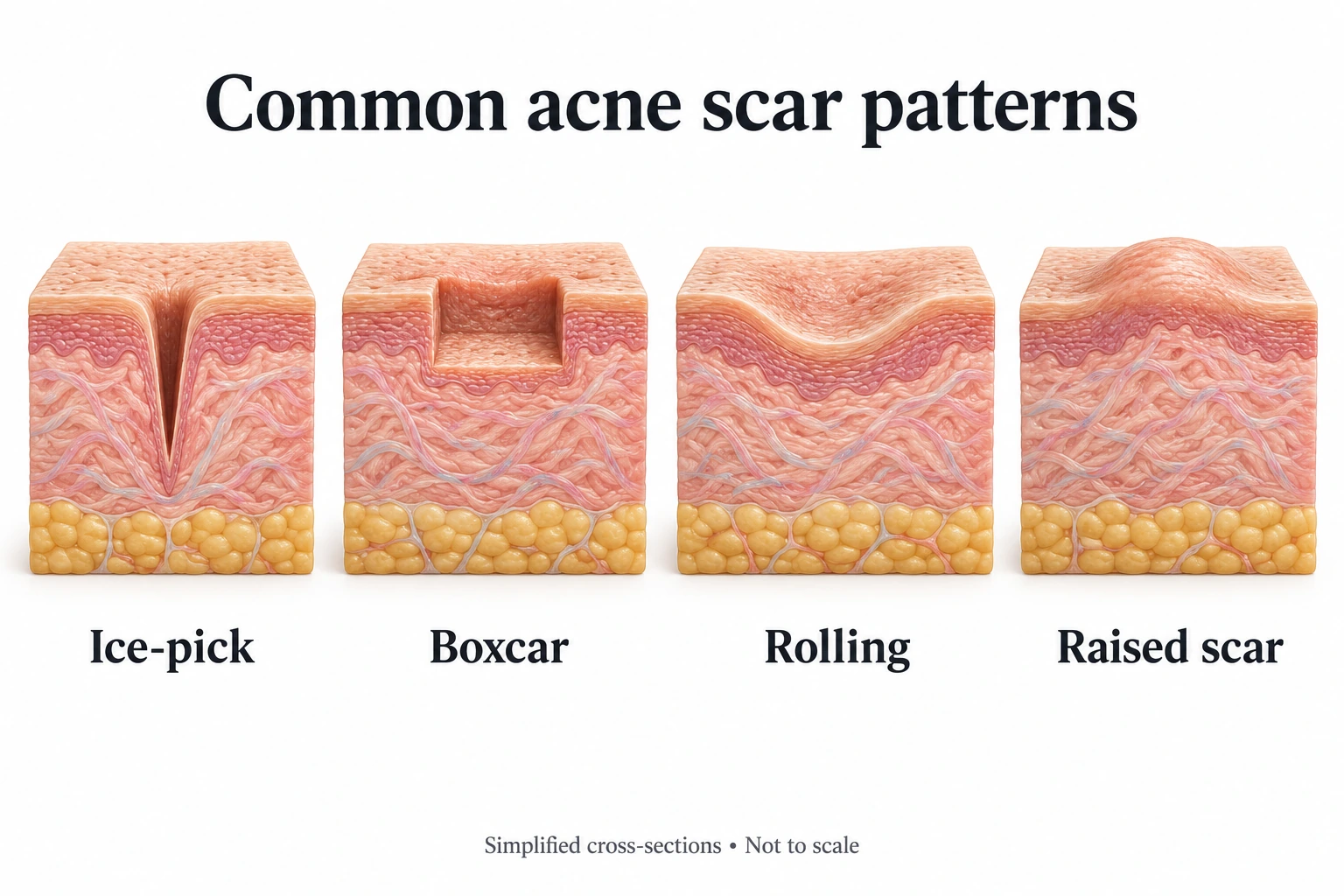
“Acne scars” can describe several different features. Singapore HealthHub identifies depressed and raised scar patterns, including:
- Ice-pick scars: narrow and deep depressions.
- Boxcar scars: broader depressions with more defined edges, which may vary in depth.
- Rolling scars: broad, sloping unevenness; underlying tethering may contribute in some cases.
- Raised scars: tissue above the surrounding skin, requiring a different assessment from depressed scars.
You may also have flat dark or red marks. These colour changes are not the same as structural depressions, even when they appear together. A treatment aimed at texture should not automatically be expected to address every pigment or redness concern.
For deeper, tethered or raised scars, the doctor may discuss another approach or referral. The American Academy of Dermatology explains that scar treatment is individualised, and some plans use more than one method. That is different from assuming that everyone needs a combination.
Compare the decision factors—not claims of a universal winner
Use these questions to make the discussion practical:
What feature are we trying to improve? Ask whether the main target is a particular depression, wider uneven texture or another concern. A clear target makes it easier to understand what the proposed treatment may leave unchanged.
How has my skin reacted before? Mention prolonged darkening, lightening, redness, unusual healing or irritation after previous procedures. Skin tone matters, but it is not the only part of assessment. RF should not be described as automatically safe for every darker skin tone, nor CO2 as automatically unsuitable.
Is active acne affecting the plan? New breakouts and current medicines can influence the sequence of care. The doctor may want to address acne before concentrating on established scars. Do not change prescribed treatment without advice.
What recovery can I manage? Ask about expected skin changes, aftercare, sun exposure, exercise, makeup and return to usual activities for the actual plan. A generic “downtime” number cannot account for every treatment intensity or skin response.
How will we judge improvement? Discuss your main goal, how the response will be assessed and when another treatment would—or would not—be worthwhile. Ask what you should realistically expect to remain visible.
How Dr. Chio Aesthetic and Laser Centre, Bedok can help you compare your options
At Dr. Chio Aesthetic and Laser Centre, Bedok, you can bring your scar concerns to a consultation that considers both Secret RF and eCO2 Plus, where appropriate. The value is in connecting a treatment approach with your skin and priorities, not simply offering a choice of names.
Tell the doctor what you want to feel more confident about: perhaps a patch of uneven texture or depressions that are noticeable in ordinary lighting. Then ask for an explanation of why one option is being considered, what alternatives exist and whether the plan should be staged.
A clear proposal should help you understand the intended improvement, the practical recovery commitment and the limits. It may focus on one treatment, sequence different care or recommend a different pathway. You can also ask for the consultation fee, proposed course costs and what follow-up would involve before making a decision.
Understand the safety differences before committing
Both approaches require an individual risk discussion. Redness, swelling and discomfort can occur, while infection, pigment changes and scarring are possible complications. Ask which risks are especially relevant to your skin, history and the proposed procedure.
RF microneedling also has potentially serious risks. The US FDA’s safety communication describes reports of burns, scarring, fat loss, disfigurement and nerve damage with certain uses, sometimes requiring medical or surgical treatment. This informs the safety discussion; it does not establish that every device or treatment plan has the same risk.
For CO2 resurfacing, ask specifically about the healing period, aftercare and pigment-change risk. For either option, disclose medicines, previous procedures and relevant medical conditions. Get clear instructions on whom to contact if recovery is not progressing as expected.
Bring these details to your Bedok consultation
Prepare your skincare and medication list, previous treatment details, any unusual skin reactions and a few priorities for improvement. Mention work, travel or upcoming events that may affect recovery planning. If you have progress photographs, keep them unfiltered and use them to support—not replace—the examination.
Contact Dr. Chio Aesthetic and Laser Centre, Bedok to ask about an acne-scar assessment and how Secret RF or eCO2 Plus may fit your concerns. You can also enquire through WhatsApp.
The clinic is at 158 Bedok South Ave 3 #01-581, Singapore; telephone +65 6442 8375. Start with your skin goals, and let the consultation help you compare the relevant options.
Frequently asked questions
Is Secret RF better than fractional CO2 for acne scars?
There is no universal winner for every person or scar pattern. Ask how the features of your scars, your skin history and recovery needs affect the recommendation. Comparing treatment names without those details can miss what matters most.
Can I combine Secret RF and CO2 laser?
Some scar plans use more than one approach, but that does not mean a combination is appropriate for you. The doctor should explain the purpose, order, timing and risks of each step before you consider a combined plan.
Which treatment removes scars permanently?
Neither should be presented as a guarantee of complete scar removal. The goal is improvement in suitable concerns, and the response varies. Discuss what could change, what may remain and how progress would be reviewed.